
Competing for AI Recommendations, Not Just Search Rankings
Recent travel research from Deloitte suggests that a meaningful shift is already underway in how travelers plan their trips. Their 2026 Summer Travel Survey found that the percentage of travelers using generative AI for travel research increased from 10% in 2024 to 25% in 2026. Adoption is particularly strong among younger travelers, with 36% of Millennials and 33% of Gen Z travelers reporting that they use generative AI as part of the travel planning process. More importantly for hoteliers, Deloitte found that among travelers already using AI, more than half use it to research accommodations.
While the survey does not tell us exactly how travelers are using these tools, one emerging use case is using AI as a planning partner rather than simply a search tool. Instead of starting with a destination, travelers can begin with preferences, interests, and desired experiences.
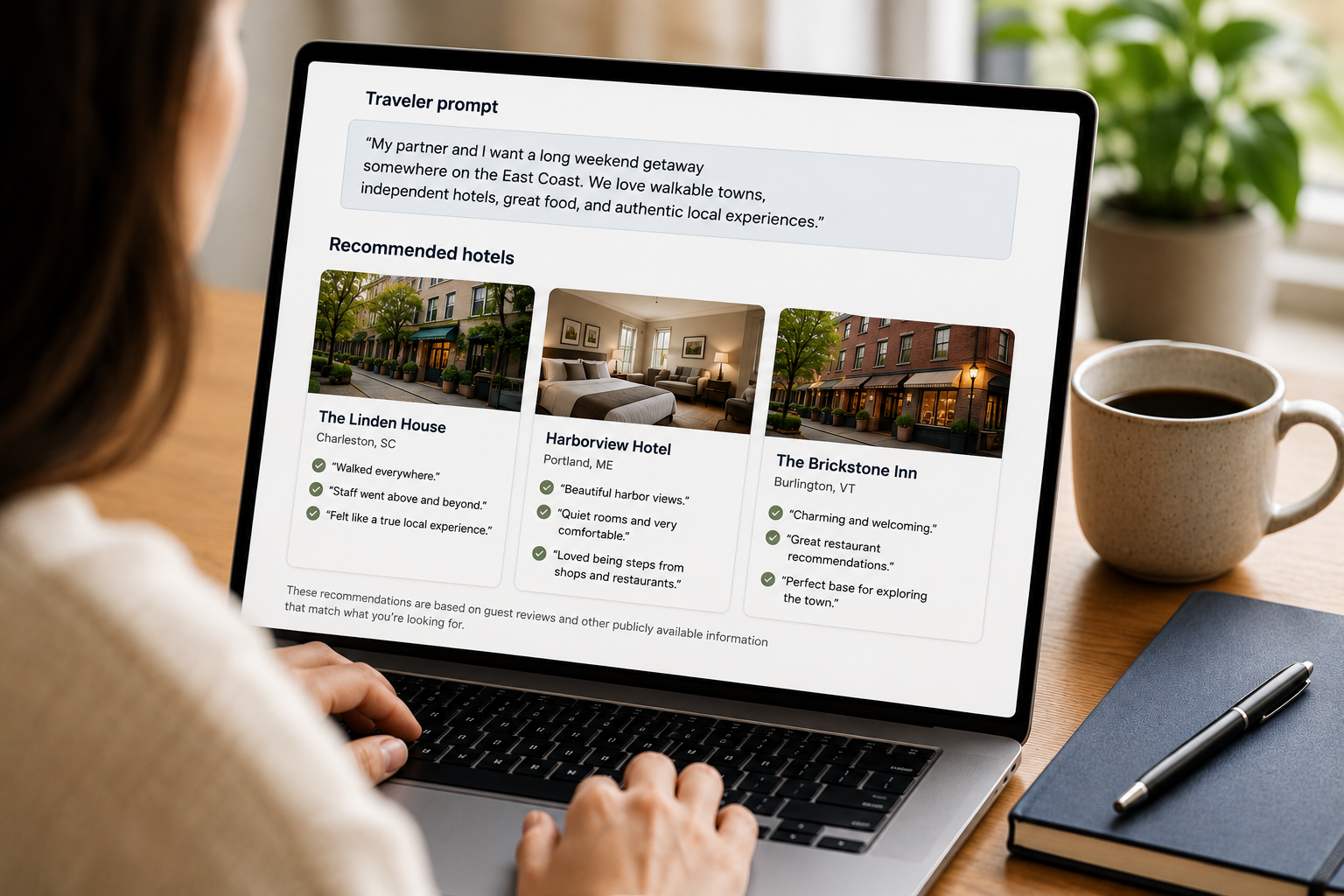
Consider how a traveler might use AI to brainstorm trip ideas with a prompt like this: "My partner and I want a long weekend getaway somewhere on the East Coast. We love walkable towns, independent hotels, great food, and authentic local experiences."
What makes this request interesting is that it contains very little of the information that traditionally drives hotel search. The traveler is not asking for a destination, hotel brand, or amenity package. Instead, they are describing a desired experience.
Historically, travelers did the work themselves. They researched destinations, compared properties, read reviews, visited websites, and narrowed the field on their own. Increasingly, AI systems may perform much of that analysis before presenting a traveler with a shortlist of recommendations. That distinction has important implications for hotels because, for most of the internet era, success depended largely on visibility.
Hotels competed for rankings, search traffic, OTA placement, map visibility, and review scores. Recommendation-driven discovery introduces a different challenge. Hotels may increasingly find themselves competing not simply to be found, but to be recommended.
To determine which hotels belong on a shortlist, an AI tool asked to recommend hotels will likely look for evidence. If a property describes itself as a boutique hotel with exceptional service, do guests describe it the same way? If the hotel promotes its walkable location, do guests repeatedly mention nearby restaurants and local experiences? If it positions itself as ideal for couples, families, or business travelers, does the available evidence support those claims?
The question for hoteliers is no longer just “What do we say about ourselves?” but also “What evidence supports what we say about ourselves?”
The Missing Evidence Problem
The challenge, currently, is that an AI tool attempting to recommend hotels is likely working with an incomplete body of evidence.
The December 2025 GuestInsight Consumer Hotel Survey found that 84% of travelers check online reviews before booking a hotel, yet 52% report that they never post public reviews themselves. Most travelers rely on guest feedback, while a majority contribute none of their own.
That gap becomes even more significant when we examine who actually chooses to participate. Public reviews tend to attract guests at the emotional extremes. The guest who had a remarkable stay is motivated to share it, and so is the guest who had a disappointing one. The much larger group of guests whose experiences fell somewhere in between often remains underrepresented.
The result is that the public reputations of many hotels are shaped primarily by enthusiastic advocates and frustrated critics, while receiving comparatively little input from guests whose experiences fall somewhere in the middle. If recommendation systems increasingly attempt to understand what a traveler is likely to experience at a property, the quality and representativeness of the available evidence may become just as important as the quantity.
Whether hotels can fill some of those gaps themselves is a more complicated question than it first appears. Our research suggests that generating a broader and more representative body of guest feedback remains a significant challenge. Only 19% of travelers reported frequently participating in hotel surveys, and nearly 60% said hotel surveys sometimes, often, or always feel more like marketing than genuine feedback collection.
Those findings point to a broader issue. Hospitality organizations routinely devote significant attention to every stage of the guest journey, from website design and reservation flow to guestroom experience and service delivery. Yet the request for feedback often receives far less strategic attention, despite being one of the final interactions a guest has with the brand.
This may represent a missed opportunity. Better feedback collection does more than improve operational visibility. It can increase participation, uncover insights that would otherwise remain hidden, identify opportunities for service recovery, encourage more public reviews from satisfied guests, and generate testimonials that help future travelers understand what guests actually experience at the property.
One finding from our study was particularly revealing. Twelve percent of respondents said they complete guest surveys because they appreciate the way the hotel asked for feedback. While not a majority, it suggests that feedback participation is influenced not only by the survey itself, but by whether the invitation feels consistent with the hospitality experience that preceded it. Guests may respond not only to the request, but also to whether the request reflects the same attention to detail and hospitality they experienced throughout the rest of their stay.
Creating More Experience Evidence
If recommendation systems increasingly rely on evidence, the implication for hotels is straightforward: they need more of it. That starts with collecting more representative feedback. A hotel that hears only from its loudest advocates and harshest critics is operating with an incomplete picture of the guest experience. The goal should be to encourage participation from a broader cross-section of guests and reduce the friction that prevents many travelers from sharing feedback at all.
Collecting feedback, however, is only the first step. The larger opportunity lies in transforming private guest intelligence into appropriate forms of public evidence. Guests who report positive experiences can be encouraged to share reviews on public platforms. Particularly insightful comments can be incorporated into testimonial content with permission. Recurring themes can be highlighted on the hotel's website, helping prospective guests understand what previous guests consistently valued about the experience.
This distinction is important. The goal is not simply to accumulate more reviews or survey responses. The goal is to build a richer and more representative body of evidence about what guests actually experience at the property. Over time, that evidence can help validate the promises a hotel makes about its service, location, amenities, and overall guest experience, while creating a body of information that is discoverable by future travelers and the AI tools increasingly helping them make travel decisions.
Will AI Understand Your Hotel?
For years, hotels have focused on influencing the traveler's decision-making process. They've invested in websites, reviews, photography, content, reputation management, and marketing because the traveler was the one evaluating the options.
AI-assisted planning introduces a new dynamic. Increasingly, there may be an intermediary layer between the traveler and the hotel; one that is attempting to evaluate those options on the traveler's behalf.
That shift changes the nature of the challenge. The question is no longer simply whether a traveler can find your hotel. It is whether a recommendation system can understand why your hotel deserves to be recommended in the first place.
Hotels that can clearly demonstrate who they serve, what they do well, and what guests consistently experience may have an advantage in that environment. Not because they have optimized for AI, but because they have built a richer, more credible body of evidence around the guest experience.
Start Listening to Your Guests More Clearly
See how GuestInsight can help your property capture better feedback, generate more positive reviews, and strengthen guest loyalty.